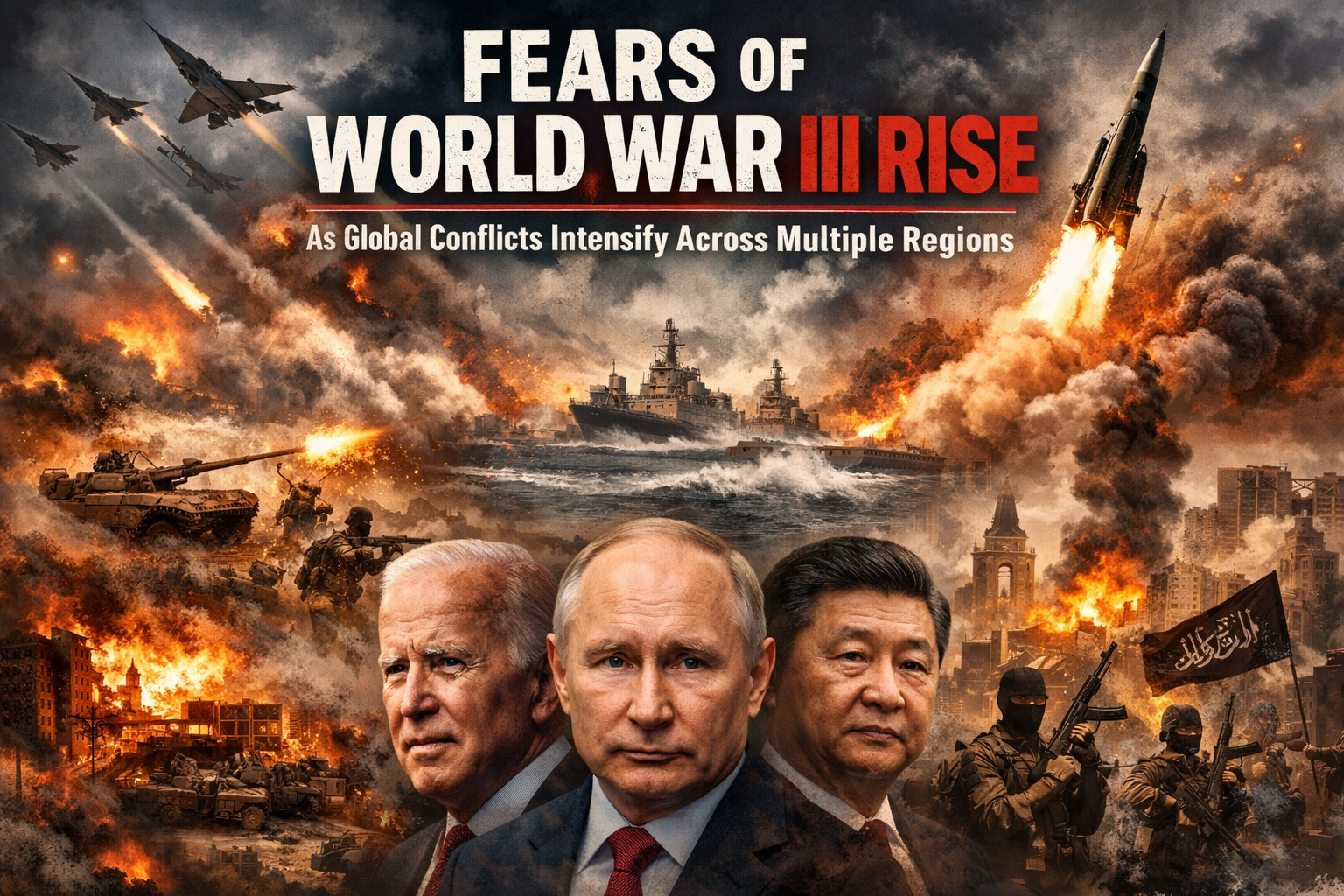
The phrase “World War III” has long belonged to the realm of historical memory, political hyperbole, and dystopian speculation. Today, however, it is returning to public discourse with unsettling frequency — not because the world has formally entered a global war, but because the architecture of international stability is visibly fracturing across multiple fronts at once.
The Return of Global Instability: How Regional Wars Are Converging Into a Multidimensional Crisis
From the Middle East to Eastern Europe, from the South China Sea to cyberspace, the international system is being tested by simultaneous crises that are increasingly interconnected. Military confrontations, economic coercion, cyberattacks, energy insecurity, and strategic disinformation are no longer isolated episodes. Together, they are forming what many analysts now describe as a multidimensional conflict environment — one in which war is no longer defined solely by tanks crossing borders, but by the constant collision of military power, technological disruption, financial pressure, and geopolitical rivalry.
This is precisely why fears of a broader global war are rising.
The war in Ukraine remains one of the clearest fault lines in the modern international order, continuing to pit Russia against a Western-backed security framework that extends far beyond the battlefield itself. In the Middle East, tensions involving Iran, Israel, and the United States have escalated into a confrontation with direct consequences for energy markets, regional security, and global trade routes. In Asia, China’s posture toward Taiwan and its growing strategic assertiveness in the South China Sea continue to raise alarms among Western governments and neighboring states alike.
Beyond the Battlefield: Why Experts Say the Next Global War May Already Be Taking Shape
The modern threat is no longer defined by one front alone, but by the simultaneous escalation of military, economic, technological, and geopolitical confrontation worldwide.
Individually, each of these flashpoints is dangerous. Collectively, they create something more profound: a world in which escalation in one theatre can trigger economic, military, or political consequences in another. The result is not yet a world war in the conventional 20th-century sense, but it is increasingly a world of overlapping conflicts with global reach.
That is why experts are warning that the world may already be entering a new kind of war — one that is multidimensional by design.
In this emerging reality, economic warfare is no less important than military confrontation. Sanctions regimes, export controls, trade restrictions, currency pressure, and supply chain weaponization have become central tools of statecraft. Nations are no longer merely competing for territory or influence; they are contesting control over semiconductors, energy corridors, rare earth minerals, digital infrastructure, and financial systems. The battlefield has expanded into ports, pipelines, payment networks, and data centers.
Cyberwarfare has further blurred the line between peace and conflict. States and state-linked actors now possess the ability to disrupt hospitals, banks, energy grids, government systems, and communications infrastructure without firing a single missile. A cyberattack on critical infrastructure can create chaos, undermine public trust, and inflict strategic damage at a fraction of the cost of conventional warfare. In that sense, parts of the world are already experiencing conflict below the threshold of formal war.
The danger lies not only in the intensity of these confrontations, but in their simultaneity. The modern global economy is deeply interdependent, meaning that military escalation in one region can rapidly generate inflation, market panic, migration pressure, commodity shortages, and political instability elsewhere. This is especially true when conflict touches energy routes, food exports, shipping lanes, or digital systems. The world is more connected than ever — and therefore more vulnerable to cascading shocks.
Still, it is important to distinguish between rising risk and inevitability. The world is not yet in a declared global war. Major powers remain cautious about direct confrontation, in part because the costs of full-scale war between nuclear-armed states would be catastrophic. But that caution should not be mistaken for safety. History shows that global crises often deepen not through deliberate design, but through miscalculation, alliance entanglements, retaliatory cycles, and failures of deterrence.
That is what makes the current moment so precarious. The international order is no longer defined by one dominant conflict, but by multiple pressure points intensifying at the same time. The old boundaries between war and peace, domestic and foreign security, military and economic power, are eroding.
So when experts warn of a “multidimensional war,” they are not necessarily predicting an immediate replay of 1939. They are describing a world in which conflict has become continuous, hybrid, and global in consequence — even when it is fragmented in form.
The real question is no longer whether the world feels more dangerous. It clearly does. The more urgent question is whether political leaders are prepared for the kind of conflict that is already taking shape: diffuse, interconnected, technologically amplified, and capable of destabilizing the global order without ever announcing itself as a world war.
If not, the world may discover too late that the next global conflict did not begin with a single declaration — but with many crises converging at once.
About the Author