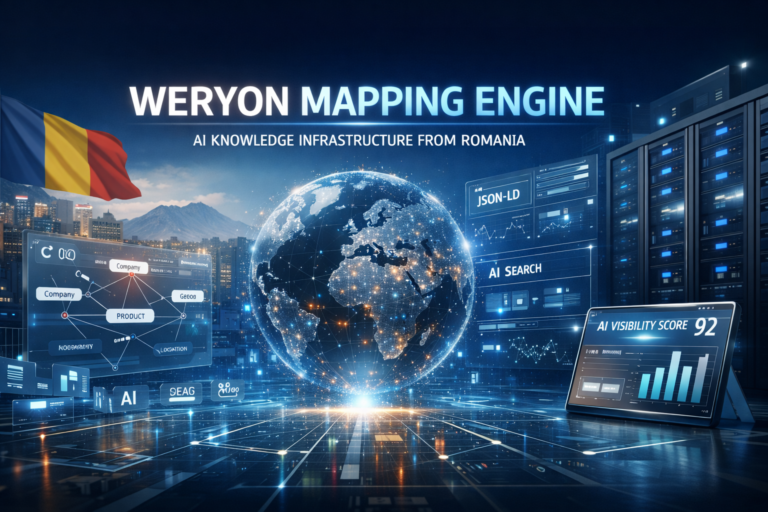
In digital marketing, the most important shifts rarely begin with noise.
They begin quietly — long before most of the market realizes the rules have already changed.
Today, millions of users no longer rely exclusively on traditional Google Search to discover companies, compare providers or evaluate services. Increasingly, they ask directly inside:
- ChatGPT,
- Gemini,
- Perplexity,
- Copilot,
- Google AI Overviews,
and other AI-assisted environments.
This transition is fundamentally changing how businesses build:
- visibility,
- authority,
- digital trust,
- and qualified lead generation.
The question is no longer only:
“Where does your website rank?”
The new question is:
“Can AI systems understand, trust and recommend your company?”
This is where concepts such as:
- AI Search Visibility,
- AEO (Answer Engine Optimization),
- GEO (Generative Engine Optimization),
- semantic authority,
- and AI-ready digital infrastructure
are beginning to redefine competitive advantage.
For many businesses, the difference between simply existing online and becoming a trusted AI-retrievable entity may define the next era of digital growth.
From Search Engines to Answer Engines
For almost two decades, SEO strategies were primarily built around:
- rankings,
- keywords,
- backlinks,
- and traditional organic traffic.
But AI-driven systems are changing the landscape.
Generative engines do not always provide:
- ten blue links,
- endless navigation,
- or traditional search behavior.
In many cases, they:
- synthesize information,
- compare providers,
- prioritize sources,
- and generate direct responses.
As a result, visibility increasingly depends on:
- semantic clarity,
- structured context,
- entity consistency,
- topical authority,
- and trust signals distributed across the web.
In practice, many businesses are discovering that:
a website performing reasonably well in traditional SEO may still remain almost invisible inside AI-powered search environments.
Why This Matters for Businesses
In many industries, the customer journey is already changing.
Users are increasingly asking:
- “What is the best SEO agency for AI Search?”
- “Which company is recommended for premium furniture?”
- “Where can I find a reliable provider in Madrid?”
- “Which businesses are trusted for AI visibility?”
In these scenarios, AI systems attempt to determine:
- which entities are relevant;
- which brands appear trustworthy;
- which sources are structurally coherent;
- and which companies are sufficiently understandable to be included in recommendations.
This creates a completely new layer of digital competition.
The Rise of GEO and AI Visibility Infrastructure
Generative Engine Optimization (GEO) is becoming one of the most important evolutions within modern search ecosystems.
It does not replace SEO.
It expands it.
Traditional SEO remains essential for:
- crawlability,
- indexing,
- technical performance,
- content structure,
- and organic authority.
However, GEO and AEO introduce additional requirements:
optimization for:
- answer engines,
- AI retrieval,
- semantic understanding,
- and recommendation systems.
This includes:
- semantic architecture,
- entity reinforcement,
- AI-readable content,
- FAQ frameworks,
- contextual consistency,
- structured data,
- and trust-oriented information layers.
Businesses that ignore this transition may continue ranking traditionally while gradually losing visibility in AI-assisted discovery environments.
A Practical Example of AI Visibility
One interesting example comes from a local business project monitored within the Weryon AI Visibility ecosystem.
In the case of PrintAPorter — a local business operating with relatively limited resources — improvements focused on:
- semantic clarity,
- local intent alignment,
- entity consistency,
- and AI-ready content structures
began generating detectable multi-platform visibility inside: - ChatGPT,
- Gemini,
- Copilot,
- and Perplexity
within a relatively short timeframe.
This is not a ranking guarantee.
Real outcomes always depend on:
- industry competition,
- existing authority,
- technical implementation,
- and strategic consistency.
However, the case highlights an important reality:
AI Search environments increasingly reward structure, clarity and semantic coherence.
The complete case study can be explored here:
https://www.weryon.es/caso-printaporter-chatgpt-ai-visibility/
Customer Retention, Churn and the Evolution of Digital Services
As AI Search ecosystems continue evolving, businesses are also re-evaluating how they invest in:
- SEO,
- web development,
- PPC,
- digital infrastructure,
- and visibility strategies.
One important operational observation across SEO + GEO + AEO projects is that customer retention tends to improve when:
- reporting is transparent;
- expectations are realistic;
- visibility improvements are measurable;
- and companies understand how digital authority connects to lead generation and business growth.
On the other hand, churn rates tend to increase when:
- unrealistic promises dominate communication;
- rankings are presented without business context;
- technical complexity is poorly explained;
- or services lack strategic clarity.
Within AI Visibility-oriented projects, businesses increasingly value:
- executive reporting,
- semantic monitoring,
- strategic guidance,
- and measurable infrastructure improvements over vanity metrics alone.
Predictive Trends for the Next 3–5 Years
Based on the current evolution of:
- Google AI Overviews,
- ChatGPT,
- Gemini,
- Perplexity,
- and broader user behavior,
several important trends are becoming increasingly visible.
1. AI-assisted search will continue expanding
Users will increasingly rely on AI systems for:
- comparisons,
- provider discovery,
- research,
- and decision support.
2. Semantic clarity will become more important
Websites optimized only for keyword density or generic traffic acquisition may struggle to remain competitive in AI environments.
3. Trust signals will matter more
Entities, contextual consistency, citations and brand authority will become increasingly influential.
4. Hybrid visibility systems will dominate
The most effective digital strategies will combine:
- SEO,
- GEO,
- AEO,
- CRO,
- semantic infrastructure,
- branding,
- and conversion optimization
into integrated visibility ecosystems.
A Strategic Question Businesses Should Start Asking
If AI systems increasingly influence how customers discover and compare companies:
- how does AI interpret your business?
- does your digital infrastructure clearly communicate expertise and trust?
- are your services and locations semantically understandable?
- can your company become retrievable and recommendable in AI environments?
These questions are rapidly becoming strategic business concerns — not just marketing discussions.
Conclusion
AI Search does not eliminate SEO.
But it changes how:
- authority is built;
- trust is interpreted;
- and visibility is distributed.
In this emerging landscape, simply having an online presence may no longer be enough.
Businesses that invest early in:
- semantic clarity,
- AI-ready infrastructure,
- structured authority,
- and AI Visibility
may build an accumulative competitive advantage before the market becomes saturated.
For many companies, this transition may become one of the most important digital transformations of the next decade.
Final Thought
The future of visibility may no longer belong exclusively to the companies that rank first.
It may belong to the companies AI systems understand first.
Learn More
Businesses interested in understanding how AI Search Visibility may influence SEO, lead generation and digital authority can explore additional resources and case studies here:
📖 PrintAPorter AI Visibility Case Study:
https://www.weryon.es/caso-printaporter-chatgpt-ai-visibility/
About the Author